Low-Prep, Standards-Based Resources for Upper Elementary

How to Teach Perspective and Point of View (So Students Get It)

08/05/2025

Point of view is who’s telling the story. Perspective is how they see it: shaped by emotion, experience, and bias. Students can absolutely learn the difference. Here’s how to get them there!

Need an activity ASAP? Learn more about my standards-based stations on TPT:

Table of Contents

A guide to this tricky literary standard.

Let’s be real: this standard is a beast. Adults have a hard time explaining the narrator’s point of view or a character’s perspective. And yet somehow, we’re expected to teach it in 20 minutes with a basal reader and hope it sticks?

New to the blog? I’m Marianna, and I create resources that help students think—not guess—and I’ve spent a bit of time figuring out what actually works for this standard. Let me show you what helped my students go from blank stares to thoughtful responses.

Starting Point: Definitions

It’s easy to confuse these two terms, so let’s start with a working definition of each:

Point of view tells you who is narrating the story—whether it’s a character or an outside observer. The narrator’s role shapes what the reader knows and how they experience events.

Common types:

  • 1st Person: A character inside the story (“I went to the store.”)

  • 3rd Person Limited: A narrator who only knows one character’s thoughts

  • 3rd Person Omniscient: An all-knowing narrator with access to everyone’s inner world

Perspective is the lens a character sees through. It’s their worldview—built on background, emotions, and experience. Two characters can witness the same event but describe it completely differently. That’s perspective.

It’s the difference between “I saw what happened” and “Here’s what I think happened.”
Also note:

When discussing point-of-view, the term “narrator” is used to describe the character telling the story.

Here are some common POVs found in upper elementary texts:

  • 1st person- told from the perspective of a character in the story, using the pronouns “I,” “we,” and “us,” among others.
  • 3rd person limited- told from the perspective of a person outside the story, who only has access to one character’s thoughts and feelings.
  • 3rd person omniscient- told from the perspective of an “all-knowing” source outside of the story. The narrator has access to every character’s inner and outer feelings.

What Students in Grades 3-5 Need to Know About Perspective and Point of View

In 3rd grade, the standard focuses on explaining different characters’ perspectives in a literary text. Point of view is only referred to in terms of who the narrator of the story is.

4th graders will “identify the narrator’s point of view and explain the difference between a narrator’s point of view and character perspective in a literary text.” 

In 5th grade, students move toward describing how the author develops a character’s perspective throughout a literary text. 

Perspective and POV Activities

These activities go beyond multiple choice and help your students truly understand the difference between perspective and point of view. BTW, if you’re thinking “picture books?” trust me…upper elementary students still love being read to!

Chart It Out

For this activity* I would recommend the book, “They All Saw a Cat” by Brendan Wenzel. As you read the story, list characters and their perspectives in one column and the narrator’s point of view in the other. What you want students to notice is that the perspectives change while the point of view (3rd person) stays the same. Then, repeat this activity on another day with a book where the POV may change.

Dear Diary

Grab a favorite picture book that uses multiple perspectives ( such as “Voices in the Park” by Anthony Browne). Have students continue the story of one of the characters in the book as a diary entry, or from the perspective of a character that is not heard from in the book (for example, with “Voices” students could write from the perspective of the dogs). 

This is a great activity to do with “twisted” fairy tales. Students will be familiar with the plots of these classic stories, so they will be quick to note the change in perspective!

Perspective Detective

One of my favorite class purchases of all time was a set of magnifying glasses. I mean really, what sounds more enticing than “Let’s be Perspective Detectives!” Use a favorite read aloud or chapter book for this activity. You can read the text out loud and have students hold up their magnifying glasses each time a new perspective is mentioned. Or, provide students with a text selection to read with their magnifying glass, underlining different perspectives in different colors. (Once again…yes, your upper elementary friends will love it!)

Dig Deeper with Perspective and Point of View Comprehension Stations

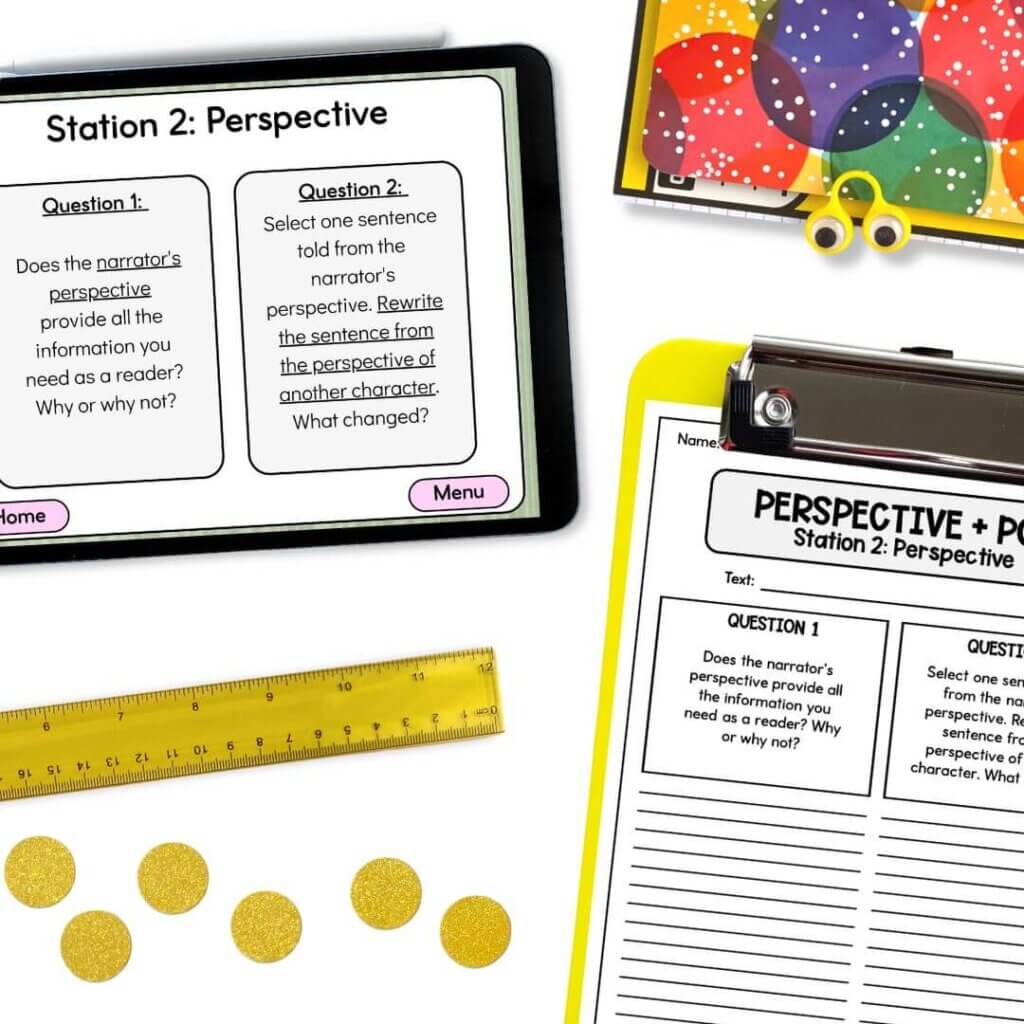
Ready to go beyond anchor charts? These stations help students apply what they’ve learned through hands-on, standards-aligned practice.


They’re perfect for test prep or small group differentiation.

This post may contain affiliate links and I may earn a small commission when you click on the links at no cost to you. As an Amazon Associate, I may earn commissions from qualifying purchases on Amazon.com.

Frequently Asked Questions About Perspective and Point of View

Perspective is how a character sees things based on how they feel and what they’ve experienced. It can change based on what happens to the character during the story.

Yes! These questions are often missed on standardized tests simply because students are unsure of how the two concepts differ.

Absolutely! Start with smaller text selections with obvious perspectives and scaffold from there.

Picture of Marianna Monheim

Marianna Monheim

Marianna Monheim is a teacher-turned-curriculum creator who helps educators ditch the fluff and teach real thinking. When she’s not creating classroom-ready tools, she’s probably watching Bravo and drinking Dr. Pepper (ice cold from the bottle).