by: Marianna Monheim
Published June 18, 2025 | Updated September 21, 2026
Teaching RL.3.1 means helping students ask and answer questions, find relevant text evidence, and explain how that evidence supports their answers.
For many third graders, that last part is new. In second grade, RL.2.1 focuses on using who, what, where, when, why, and how questions to show an understanding of key details. By third grade, students are expected to refer explicitly to the text as the basis for their answers.
Essentially, it is “show your work” for reading. A student may understand the story and answer the question correctly, but in third grade, the answer alone is no longer enough. Students also need to show what in the text helped them reach it.
You have probably seen the gap. You ask, “How do you know?” and a student points to the first sentence that mentions the character’s name. Another chooses a detail that is technically from the story but has very little to do with the answer. And, of course, someone confidently explains, “I just know.”
A clear, repeatable process helps students move past that point. They learn to understand the question, find a useful detail, connect it to an answer, and explain their thinking. As those steps become familiar, students can respond with less prompting and take more responsibility for their work.

Table of Contents
What Does RL 3.1 Mean for Your Third Grade Students?
If you’ve ever read a student response and thought, “That’s not even close to what the question asked…” congratulations, you’re a 3rd grade teacher!
The RL.3.1 standard asks students to ask and answer questions about a text and to support their answers using evidence from the text itself. Sounds straightforward, but in practice? It feels more like asking kids to read your mind. For them, they’re leaning heavily on guesswork or their own opinions. This is natural! Most likely, your students have had zero practice explicitly applying this skill before entering 3rd grade.
Let’s break the standard down:
Here’s what that means in plain language:
- Students should be able to ask thoughtful questions before, during, or after reading
- They should also be able to answer comprehension questions with specific evidence (not just “I think…” or “because it makes sense”)
We’re not just looking for quotes from the text, we want students to understand what the question is really asking and know how to prove the answer using the text.
Here’s what works: Teaching RL.3.1 means showing students how to slow down, look back, and find proof—not just take a guess.
What Does Mastery of "Ask and Answer Questions" Look Like?
Raise your hand if you’ve taught the skill, modeled the strategy, and still get answers like:
“Because he was sad.”
“I just know.”
“Because it’s in the story.”
The struggle is more than real, but I’m here to tell you we can get third graders over this hill.
The first thing to consider is: what does a “mastery-level” response look like?
Imagine you’ve just read a short text from your basal, and asked this question: “Why did the main character leave the party?”
BASIC
PROFICIENT
ADVANCED
“Because he wanted to go home.”
(no text reference, vague)
“He wanted to go home because he didn’t feel well.”
(clear answer, vague reference to text)
“The text says, ‘His stomach hurt and he didn’t want anyone to know.’ That’s why he left early.”
(cites specific evidence + shows understanding)
So what is it that we want? Not vague generalizations OR sentences copied directly from the text with no anchor. We’re looking for answers based on what was on the page, using short quotes or paraphrasing to support them.
…and let me tell you. This part? This is where you stay until the student gets it. Because this can be the make-or-break point between on-level or intervention.
Check for mastery by asking:
Can the student rephrase the question in their answer?
Do they use words like because, according to the text, or the author said?
Are they pulling evidence that actually supports the answer—not just something related?
Top Tip
This is where the gap starts to widen—students who cite move forward. Those who guess fall behind. Provide tons of practice before moving to more complex standards- you'll thank yourself later.
the ready-to-go solution
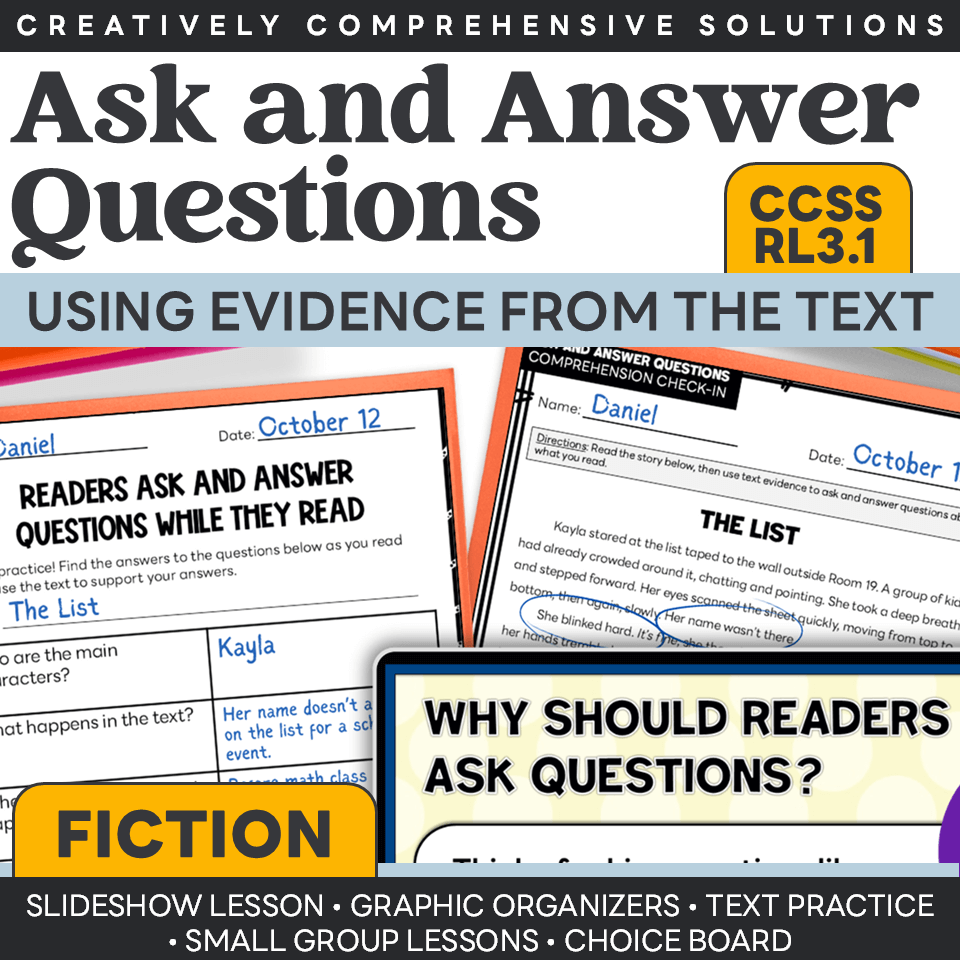
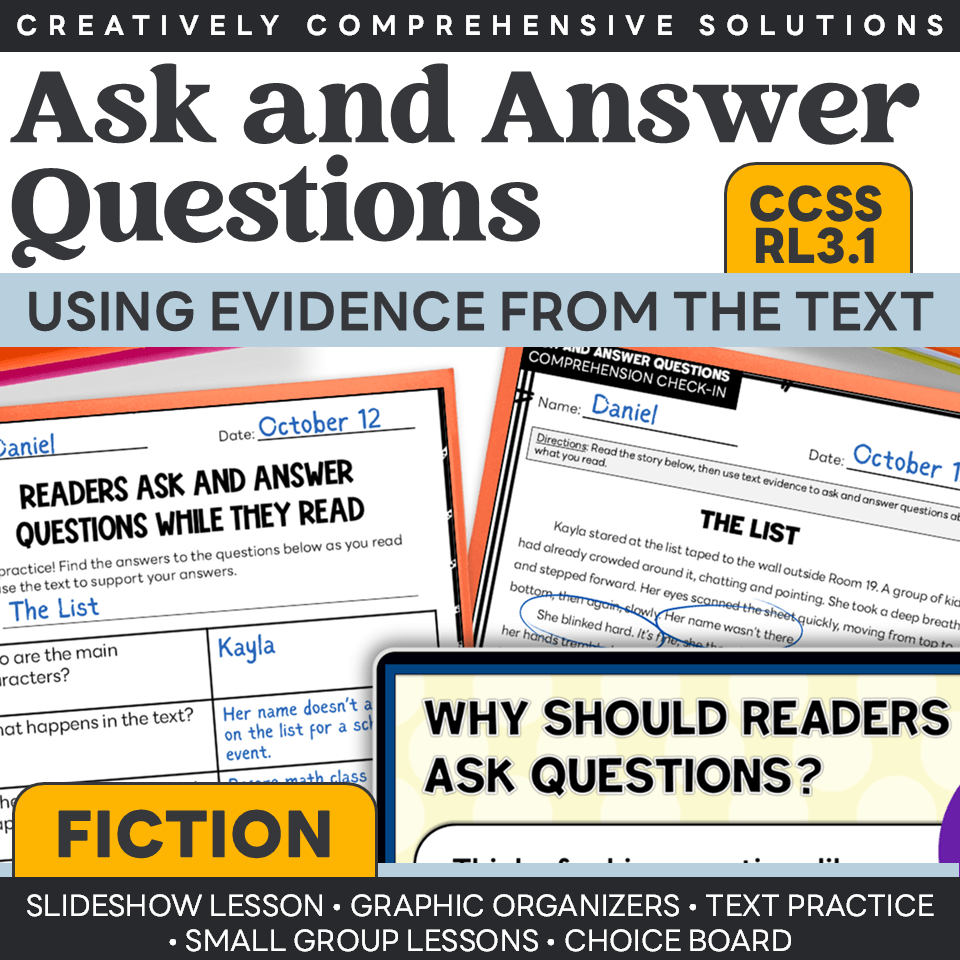
The Ask and Answer Questions resource includes modeling, guided practice, graphic organizers, and independent activities that help students move from answering a question to supporting that answer with text evidence.
How to Teach 3rd Grade Students to Ask and Answer Questions
When you think about it, this standard covers a lot. It’s more than just answering multiple-choice questions. You’re teaching the students the thinking they need to do for continued success in comprehension, which seems like a tall order. How do we tackle it? By breaking things down in a way that seems manageable to our students.
I Do - We Do - You Do
Some teaching strategies stick around because they work, and the gradual release model is one of them. We all know the phrase, “If you want something done correctly, you have to do it yourself.” Well, when using gradual release, we can modify the original saying a bit: If you want something (asking and answering questions) done right, you have to model, model, and model some more. It’s easy to make the assumption that kids ask questions about everything, so this standard will be a breeze for them. Don’t forget that we’re adding in a new element here: referring explicitly to a text. With that addition, it’s no longer an innate skill, but a learned one.
Masterful Modeling
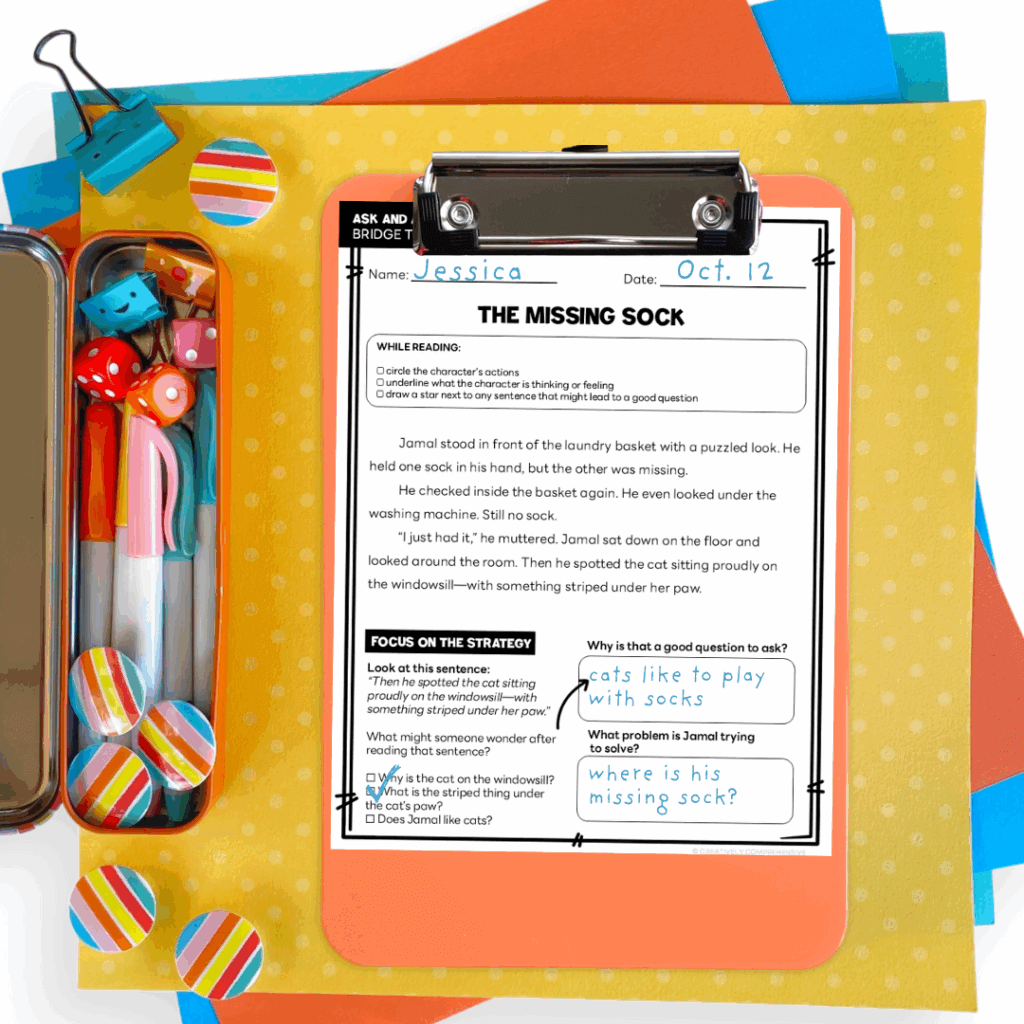
Choose a short, familiar text and walk through your thinking out loud. Pause after the question. Go back to the text. Highlight the part that helped you answer. Then craft a complete response using a sentence stem like:
Then repeat, repeat, repeat. You want your students to understand this reading behavior isn’t a one-off…it’s something they should be doing constantly as they work through a text.
After a few modeled examples, work with the students as they attempt the strategy. Again, practice until you start to hear them use the language on their own. Then, provide sentence stems or a graphic organizer so that students can try it out on their own or with a partner.
Top Tip
Don’t assume one mini-lesson is enough. Plan to cycle through this several times across multiple texts before expecting mastery.
Focus on the Skill, Not the Story
I know there are some in the comprehension world who will disagree with me here, but I personally think explicit strategy instruction is still necessary, especially when being introduced for the first time. My suggestion: start with short passages that leave no room for guesswork. You want texts that clearly state the answer as students go back and reread.
Teaching RL.3.1 With Different Texts
Students have figured out the basics of citing text evidence. Time to move on! You’d think this would be the case, but this isn’t a standard you can check off and think of as “mastered.” You’ll be embedding this skill into every reading activity you do this year, meaning you’ll come across multiple formats and different types of text.
Here’s how to encourage students to apply this strategy all year long:
Read Alouds
Read-alouds are perfect for modeling how questions come up while reading. Pause and think aloud:
“Hmm, I wonder why her friend stormed out of the house. Let’s go back and see what was happening before that…”
Important to remember: You don’t need a written response every time. Just modeling how to ask the right questions—and where to look for answers—builds habits that transfer later.
Short Text Selections
This is a perfect opener for your small group. Get in the habit of determining a question, locating evidence, and writing an answer using a sentence stem. Think about how much practice you can sneak in such a short amount of time! Don’t forget: use different types of fiction texts (poems, plays, etc.) to remind students they should look for text evidence no matter what they’re reading.
Independent Reading
Pull out those graphic organizers so students can practice on their own. This is a fantastic way to hold students accountable for their learning while you meet with your targeted small groups.
These simple activities will help students see that this standard is not just about taking a test, but a habit that readers need to develop.
If you are deciding how this skill fits into the rest of your reading block, this complete guide to reading response in grades 3–5 explains how to get useful evidence of comprehension without turning independent reading into a stack of repetitive worksheets.
Graphic Organizers and Scaffolds for Answering Questions with Text Evidence
The reality of teaching third grade right now is that you may have a majority of students who do not read at grade level. How do you provide support for all of them? It’s easier than you think.
Sentence Starters and Stems
Start here. Readers at all levels benefit from structure. Keep it simple:
“The text says _______. That shows ______.”
“According to the text, _______.”
“On page ____, it says ______, which means ______.”
Post them in your room, paste them into student notebooks, and most importantly: make it a habit to use them every day.
Avoid confusion: whatever language your school/district/state uses, use that same language when in whole group, small group, or on student practice sheets.
Visual Tools and Word Banks
Every student benefits from visual cues. Try these:
Anchor charts with sample answers
Word banks for emotions, actions, or inferencing language
Color-coded guides (question ➝ answer ➝ evidence)
But I’m worried they’re just copying. Honestly in the beginning they might be, but I’d rather students do that than stare at a blank page. Eventually the training wheels will come off!
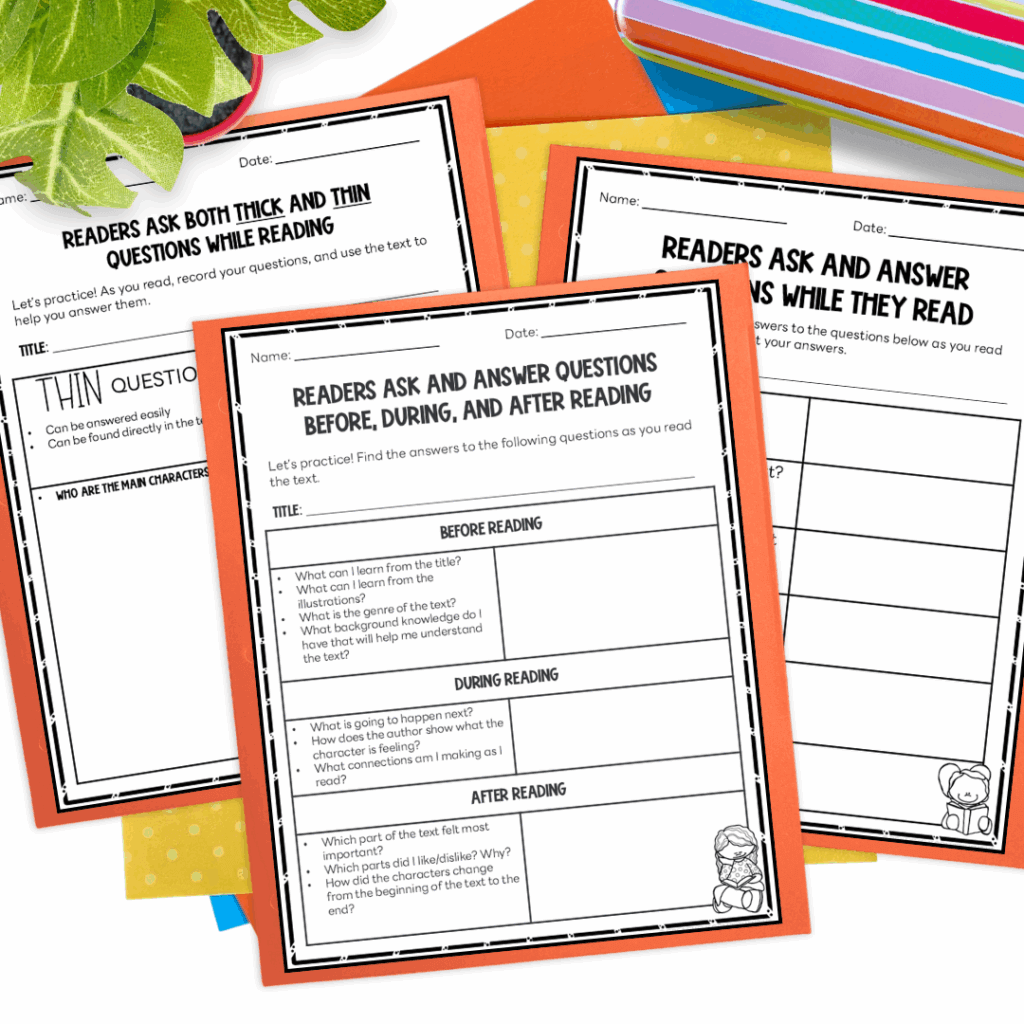
Ask and Answer Questions Graphic Organizers
As a reading coach who worked closely with intermediate grades, I often heard “We’re giving them too much, they need to be more independent.” To which I would say: the goal is independence. We have to get them there first.
Simple graphic organizers, focused specifically on one skill or action you’d like your readers to take, are the key here. Structure and practice…they’re both necessary to build towards independence.
Common Sticking Points Students Have While Asking and Answering Questions in Text
Even after students understand the basic answer-and-evidence routine, a few predictable problems tend to show up. Knowing which problem you are actually looking at makes it much easier to choose the right support.
Copying Text Without Explaining
Some students assume that finding a sentence in the text completes the job. They copy it carefully, add quotation marks if you are lucky, and wait for the checkmark.
The evidence may be accurate, but the student has not explained how it supports the answer. That connection is where the actual thinking happens.
Teach students to separate the response into three parts:
Answer the question in their own words.
Choose the shortest detail that supports the answer.
Explain what the detail shows.
Sentence frames can help students make that final connection:
“This shows that ______.”
“This detail supports my answer because ______.”
“From this, the reader can tell ______.”
If students are still highlighting half the page, give them a limit. Ask them to underline only the words they would need to prove the answer to someone who disagreed with them. This should help your highlighters last longer than the first month of school.
Asking Yes-or-No Questions
Third graders usually have plenty of questions. The challenge is getting them to ask questions that require more than a one-word answer.
Questions such as “Was the character upset?” or “Did she go home?” can check a basic detail, but they do not always lead students back into the text for deeper thinking. Model how to revise these questions using why and how:
“Why was the character upset?”
“How did the character’s feelings affect what she did next?”
“Why did she decide to go home?”
A helpful routine is to let students write their first question and then ask, “Can someone answer this with only yes or no?” If the answer is yes, challenge them to revise it so the reader must explain.
Yes-or-no questions are not forbidden. They are simply a starting point. Students need practice stretching them into questions that lead to stronger answers and better evidence.
Answering From Prior Knowledge
Sometimes a student’s answer makes perfect sense but cannot be supported by anything in the text. The student is answering from personal experience, background knowledge, or a very reasonable guess.
Those connections matter during reading, but RL.3.1 asks students to base their answers on the text. Help them separate what they know from what the author actually tells them.
When an answer seems plausible but unsupported, ask:
“What part of the text made you think that?”
“Can you point to the words that support your answer?”
“Do we know this from the story, or are we adding something we already know?”
This keeps the conversation focused on evidence without treating the student’s thinking as completely wrong. The idea may be reasonable. It just has not been proven yet.
Choosing Related but Unsupported Evidence
Tell me if you’ve heard this one before. The student understands that evidence is required and finds a sentence about the correct character or event. Unfortunately, the sentence does not actually prove the answer.
For example, a student may explain that a character is nervous and choose a sentence stating that the character entered the classroom. Both details involve the same character and scene, but entering the classroom does not prove nervousness.
Teach students to test the connection by finishing this sentence:
“This detail proves my answer because ______.”
If they cannot explain the because, they probably need stronger evidence.
You can also show students two possible details and ask which one provides better support. Comparing a related detail with a useful one helps students see that finding evidence is only the first step. They also have to decide whether it does the job.
Ready-to-Use RL.3.1 Practice
The Ask and Answer Questions RL.3.1 resource provides a complete sequence of modeling, guided practice, and independent application. You can use the full sequence or pull the activity that matches what your students need next.
When Students Need More Scaffolding
Some students are not ready to answer a question, find evidence, and explain the connection all at once. The Bridge to the Standard activities use the second-grade prerequisite skill as a starting point and break the process into smaller steps.
Students practice:
Matching questions with appropriate answers
Identifying evidence in the text
Using sentence frames to explain their thinking
Differentiated graphic organizers provide additional structure without changing the skill students are working toward.
When You Need Quick Data
Waiting until the end of the week to discover that students have been confidently choosing unrelated evidence is less than ideal.
The quick checks use a simple question, answer, and evidence format so you can see where the process is breaking down. Is the student misunderstanding the question? Struggling to locate evidence? Choosing a related detail that does not actually prove the answer?
That information helps you decide whether students are ready to move forward or need another round of modeling before the confusion follows them into the next lesson.
When Students Need Independent Practice
Once students understand the routine, they need opportunities to use it without the teacher walking them through every step.
The graphic organizers can be paired with fiction texts you are already using, including read-alouds, short passages, novels, and independent reading books. Students follow the same basic process of asking or interpreting a question, recording an answer, locating evidence, and explaining the connection.
Because the routine stays consistent, students can focus more of their attention on the text and less on figuring out what the page wants them to do.
The same principle applies to the rest of the reading block. These strategies for increasing student accountability during independent reading can help students follow expectations while you work with small groups.
When Students Need More Variety
RL.3.1 requires plenty of repetition, but repetition does not have to mean completing the same response sheet twelve times with twelve different stories.
The choice-based activities give students different ways to practice asking questions, answering with evidence, and explaining their thinking. You can use them during centers, partner work, independent reading, or as follow-up practice after a whole-group lesson.
Students still practice the same standard, but the format changes enough to keep the work from feeling like reading-response déjà vu.
(If this format is new to your students, start with these practical tips for using an independent reading choice board before expecting them to manage every option independently.)
The complete resource brings these pieces together so you can move from modeling to supported practice and then toward independent application without building every step yourself.
Try the Routine First With a Free Graphic Organizer
If your students need practice stopping to ask and track questions while they read, start with the free RL.3.1 Question Tracker.
Students can record questions as they work through a short text selection or continue adding to the organizer while reading a longer book. It gives them one consistent place to hold their thinking as they work through the text.
Download the Free Ask and Answer Questions Graphic Organizer
Need the Full Sequence?
Asking questions is one part of RL.3.1. Students also need to answer those questions, locate relevant text evidence, and explain how the evidence supports their thinking.
The complete Ask and Answer Questions resource includes the modeling, scaffolds, quick checks, graphic organizers, and choice-based practice needed to teach that full process and move students toward independent responses.