by: Marianna Monheim Updated February 10, 2026
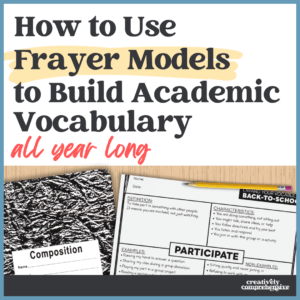
A Frayer Model is a vocabulary graphic organizer that helps students understand words by examining four key components: the definition, characteristics, examples, and non-examples. Instead of memorizing definitions, students analyze how a word works in different contexts.
Frayer Models are especially effective for academic vocabulary because they encourage deeper thinking, discussion, and meaningful word use.
Why Frayer models need to be prominent in your upper elementary classroom: Instead of students simply repeating definitions, they test the word against examples, non-examples, and traits, so the meaning gets clearer and more usable. Use the info below and you’ll hear students actually using those terms they learn across each subject in their regular, every day language.
Table of Contents
The 411 for Busy Teachers:
What it is: Frayer Model = definition + characteristics + examples + non-examples
Why it works (3–5): academic vocab gets abstract, students need more than a definition
Best move: use seasonal monthly words so the vocab feels relevant and sticks
Use filled-in models first: they model academic language and spark better discussion
The real challenge: picking the right words + strong examples and non-examples
(Grab done-for-you Frayer models in my TPT store)
Why Frayer Models Work So Well for Upper Elementary Students
Vocabulary Becomes More Abstract in Upper Elementary
Have you ever been frustrated by students simply parroting back a dictionary definition instead of being able to explain a vocabulary tern in their own words? As students move into upper elementary grades, vocabulary becomes less concrete and more conceptual. Words often have multiple meanings or are used differently across subjects, making simple definitions insufficient.
This is where vocabulary starts becoming more complex. A word can mean one thing in everyday conversation and something more precise in science, math, or informational text. Students can “know” a word and still misunderstand it in context, because the concept underneath it is fuzzy.
Frayer Models help tighten that fuzziness by forcing students to look at the word from multiple angles, not just one dictionary line.
Frayer Models Support Deeper Thinking
By including examples and non-examples, Frayer Models help students clarify misconceptions and build a more complete understanding of word meaning.
Examples are where students see what counts. Non-examples are where students learn the boundaries. And this, fellow teacher friend? Is cognition gold. Non-examples are the best way to spot misconceptions. Not to mention all those “spot the one that doesn’t belong” questions standardized test-makers love!
Discussion and Oral Language Matter
And now, my favorite reason for using Frayer models to support vocabulary. Upper elementary students benefit from opportunities to talk through their thinking. Frayer Models naturally support discussion, explanation, and academic language use.
Frayer Models are discussion prompts disguised as a graphic organizer. Students are not only naming ideas, they are justifying them: why an example fits, why a non-example does not, which characteristics matter most.
That’s also why Frayer Models are a strong fit across subjects. Whether you are working with a reading term, a science concept, or a math vocabulary word, the structure invites students to explain, compare, and refine their thinking out loud.
People Also Ask...
A Frayer Model is used to help students understand vocabulary by exploring definitions, examples, non-examples, and characteristics of a word. It supports deeper understanding rather than memorization.
Yes, Frayer Models are especially effective in upper elementary because vocabulary becomes more abstract and requires deeper analysis.
To start, focus on 1-2 words a week. As students get familiar with the Frayer format, gradually increase the amount of words you discuss.
Frayer Models are well-suited for academic vocabulary because examples and non-examples help clarify meaning across contexts.
Yes, Frayer Models encourage discussion when students explain examples, non-examples, and characteristics using academic language.
Why Monthly Vocabulary Themes Make Frayer Models Even More Effective
Seasonal Vocabulary Builds Background Knowledge
Monthly themes connect new vocabulary to what students are already experiencing, such as seasonal changes, routines, and content topics.
When vocabulary connects to what students are seeing and talking about in real life (weather changes, seasonal routines, holidays, school-year rhythms), students have more to pull from during discussion.
Need to get some of your quieter friends to join the discussion? This is a good starting place.
Monthly Themes Increase Engagement
When vocabulary feels relevant, students are more likely to participate in discussion and retain word meanings.
Relevance is not about making everything “fun.” It is about making the words easier to picture and easier to talk about. Seasonal anchors give students immediate mental images and experiences to connect to the word, which helps them contribute more confidently to examples and non-examples.
More participation also means more repetition in natural language. And repetition in real sentences beats repetition on a worksheet every time.
Using Frayer Models in Your Classroom
Frayer models are easy to introduce to your academic routines. Here’s some practical advice to get started:
Introducing Vocabulary at the Start of the Month
Model and practice with the whole class when you start working with Frayer models. This saves you from having to explain why “not glamorous” is not a non-example for “glamorous” later on.
Introduce one word at a time, so that students can practice taking one term and going deep. You might be shifting their mindset from “I need to know what these words mean because they’re on a test” to “How can I incorporate these words into my vocabulary?”
You may not be able to work out a full Frayer model every day, but keep the routine consistent, so that students understand this isn’t a one-off activity, but a tool they can use to actively expand their word knowledge.
Try Starting with Filled in Frayer Models
The pressure of filling in a blank space is real. Your students may benefit from starting with filled-out examples, so they can see how all the sections connect. Don’t think of it as a shortcut; rather, it’s a solid model of academic thinking.
A word of caution, projecting a filled out Frayer model and having students copy it down serves no one. Instead, use it as a springboard to discussion where your class adds on their own thinking.
Modeling Academic Language
Filled-in models show students how to explain word meaning clearly and precisely.
Students often have a vague sense of meaning but struggle to explain it in a clear way. A filled-in model demonstrates the kind of language that works: specific, complete, and tied to evidence.
It also gives students sentence structures they can borrow. That matters because students cannot use academic vocabulary confidently if they do not have a reliable way to talk about it.
Supporting Struggling or Hesitant Speakers
Students who struggle with vocabulary or oral language benefit from hearing examples before being asked to respond.
Some students need processing time. Some are unsure how to phrase their thinking. Some avoid participating because they do not want to be wrong in front of peers.
Filled-in models lower that barrier. Students can react to an example, agree or disagree, and explain why. That is often a much easier first step than generating an answer from scratch.
Encouraging Deeper Conversations
Instead of short answers, students are encouraged to justify examples and explain non-examples, leading to richer discussion.
The “why” is where the conversation gets good. When students defend examples and argue about non-examples, they are practicing the exact thinking skills that show up in comprehension, writing, and problem-solving.
Frayer Models support that kind of talk because the organizer basically demands it: a box with “non-examples” is a polite invitation to debate.
Gradual Release of Responsibility
Over time, you’ll want your students to move from discussing teacher-modeled Frayer Models to completing their own independently.
By starting with lots of verbal practice up front, you’ll save time by not having to call out weak work when students move to working on their own. Simply put: they’ll understand your expectations.
Faryer models also fit perfectly into small group or intervention lessons when you’ve got students who need a little more support before working on their own. If necessary, spend all week on one word, really focusing on one box of the model per day.
The Real Challenge With Frayer Models: Choosing the Right Words and Examples
The Frayer Model itself isn’t difficult to create. I’m sure you can quickly draw or print a four-square organizer on your own!
The real challenge is knowing which words to choose and how to model strong examples and non-examples, especially as vocabulary becomes more academic and abstract in upper elementary. And to be honest, it’s not something that’s easy to do on the fly.
You’re not just choosing a word, you’re:
Deciding which words are worth teaching deeply
Determining the right level of rigor for the time of year
Creating examples that prompt discussion
Modeling academic language that students can understand and use
Naturally, there are words in your textbooks you can focus on. But beyond that? Here’s my personal criteria:
High-utility words: The word shows up across lots of texts and tasks (reading, writing, discussion, multiple subjects).
Concept words, not label words: The word represents an idea students have to understand, not just a thing they can point to.
Easy to confuse: The word has common misconceptions, close cousins, or everyday meanings that conflict with academic use.
It changes the meaning of the text: If students do not understand the word, they miss the point of a passage, question, or direction.
It fosters better thinking: The word helps students explain ideas more precisely (by giving them language for reasoning).
Looking for Help with Frayer Models?
To get the most out of Frayer models, you don’t want to just throw out a four-square graphic organizer with a word in the middle. It’s important to take the time to think through relevant characteristics, examples, and non-examples. This changes it from “assignment to check off” to “real academic discussion.”
But let’s be for real. I know the last thing teachers need is to add more in-depth planning to their plates. That’s why I developed these monthly Frayer model printables.
Each monthly set removes the decision-making from the teacher’s plate by providing:
- 8–10 carefully selected academic vocabulary words connected to the month or season
- Words chosen for depth, discussion, and appropriateness for the time of year
- Printable Frayer Models ready for classroom use
- Filled-in example versions so teachers don’t have to create models from scratch
- Vocabulary that intentionally increases in rigor throughout the year
This way, you can focus on instruction and discussion, not on word selection and planning…and your students are the ones getting the cognitive workout, not you!
Click here to find my Frayer sets (more coming soon!)
Frequently Asked Questions About Frayer Models
Teachers can use filled-in Frayer Models to model thinking and prompt students to explain reasoning, compare ideas, and refine understanding.
Yes. Filled-in models support modeling, discussion, and confidence, especially for struggling or hesitant learners.
Frayer Models are most effective when used consistently as part of a year-long vocabulary routine rather than a one-time activity.
More Posts from Creatively Comprehensive