If your students think revising means adding a period and calling it done, you’re not alone.
The REAL Reason Students Skip Revising
You model it. They nod. Then you get the same draft again…or the same draft again with 75% more exclamation points. What gives? Revising demands metacognition, patience, and a clear target. Developing writers often lack all three. Without a visible process, they simply don’t know what “revising” means.
Common Barriers to Revision
Fatigue from drafting...aka "but I wrote a lot already!"
Students aren't sure what to do
Peer feedback isn't helpful
No structure or scaffolding in place
Why Does This Matter?
Research is blunt: teaching explicit strategies for planning, revising, and editing produces large gains in writing quality. So how do we get our fledgling writers to revise? The answer lies in explicit revision stations.
It’s tempting to rush past revising when every minute of writing time already feels spoken for. But skipping it doesn’t save time—it just hides the problem until the next draft (or the next teacher). No judgment here…I know how difficult it is to face a mountain of papers containing run-on sentences, weak vocabulary choices, and little to no exposition. They key is to clarify what revising is, then break it up so that it becomes approachable to all students, not just something good students do.
Revising should be approachable for all students, not just something "good writers do."
To help students understand revision, we need to put the red pen away for a moment and give them a workflow they can follow independently. Revision and editing are two different processes, as outlined by Reading Rockets, and it’s important our students understand that.
Action Steps: Turn Revising into a Visible Process
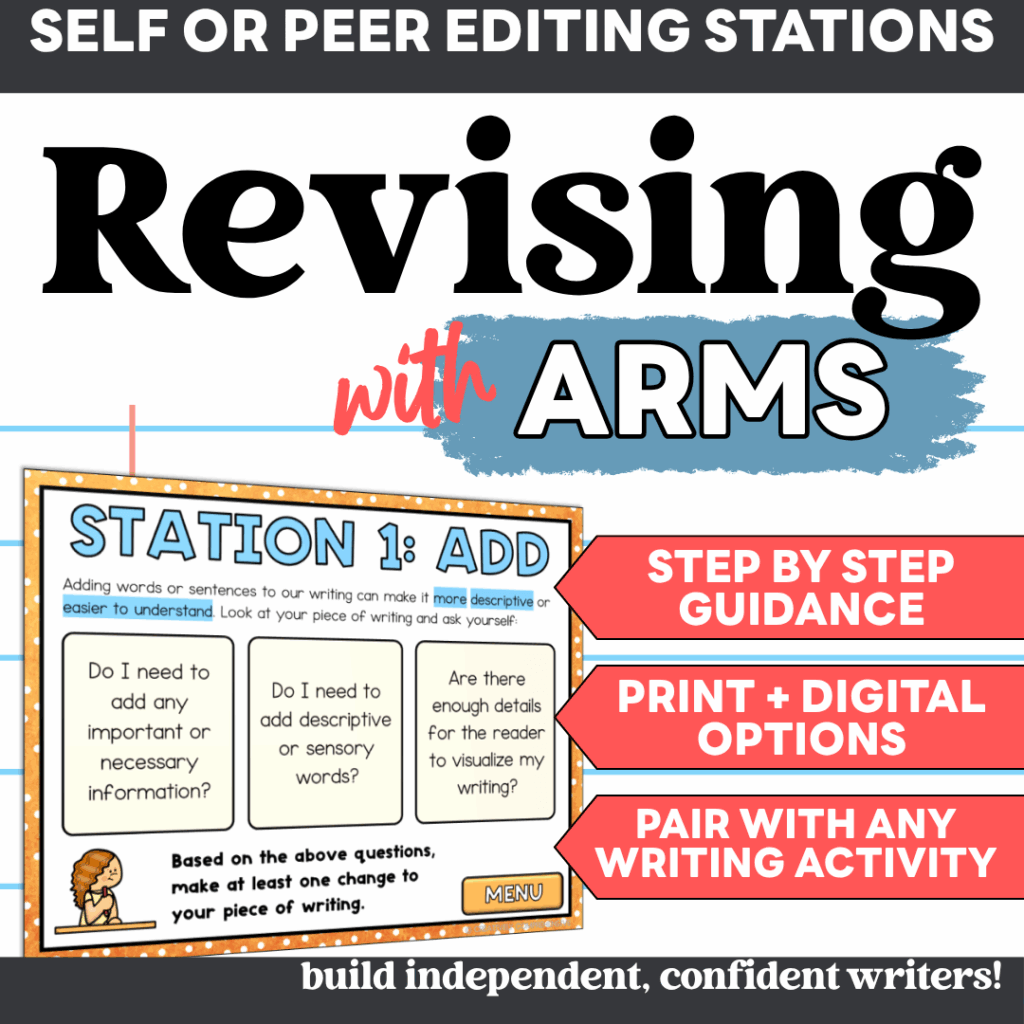
A lot of teachers post ARMS and CUPS acronyms on their walls, but do students really know what they mean? The first step towards meaningful revision is making sure students explicitly understand the difference between adding, removing, moving, or substituting words or sentences in their draft. One solution I like is isolating each skill into its own station with guiding questions. This shows students that revising is a process where we look closely at what we wrote and determine if we can make it better.
Peer Editing
Peer revision is so beneficial for our students…if they know what they’re doing. Stations allow students to review each other’s writing systematically, ensuring that their feedback reflects actual writing mechanics, rather than their own opinions. Have you ever seen a peer conference derail because Partner 1 doesn’t like the topic of Partner 2’s essay and therefore only comments in the negative? Having a specific set of questions eliminates these types of missteps when students work together.
Training Peer Editors
Keep feedback targeted to one skill at a time
Provide guiding questions to keep the conversation focused
Provide a script for more reluctant participants: “I noticed….” “Would you consider….” “This sentence wasn’t clear for me…” etc.
Accountability
Once students understand what to do, you’re going to want a system in place to see their revisions. Color-coding, an exit slip, or a simple reflection sheet stapled to their final draft holds students accountable for actually doing the work.
Quick Reflection Questions
These can work as exit slips or conversation starters during writing conferences:
“Today I fixed…”
“This change made my writing clearer because…”
“One thing I still need to revise is…”
“My partner noticed that…”
“I added ____ after feedback from ____.”
How To Set Up Revising Stations (Step-by-Step)
1. Choose 3-4 Skills to Focus On
Not sure where to start? The ARMS acronym keeps things simple:
Add words or sentences that will help the reader create vivid images while reading
Remove nonhelpful or confusing content
Move sentences to increase organizational flow
Substitute powerful words or phrases in place of weak ones
2. Label Stations Clearly
Explain what each skill means in kid-friendly language, and provide a checklist or guiding questions for further scaffolding.
Example Questions:
Did I forget any necessary information?
Will readers understand the language I use in this paragraph?
Does my paragraph order make sense to the reader?
3. Set Up Rotations That Will Work in Your Class
You may choose to work as a whole group while projecting the stations on your white board, or print out stations and have students rotate in groups.
The key here is finding the system that will work for your class…and that may change each year!
4. Model, Model, Model
If you are teaching at one of the many schools that sacrifice writing time for more reading practice, your students may not have a solid grasp on developing a piece of writing from start to finish. Choose a revising skill a day and model until students are comfortable working on their own.
5. Ask for Evidence
Whether it’s just a verbal accoutability check, an informal exit slip, or a more formal reflection sheet, make sure to have students show evidence of where they made their revision.
It’s not enough for students to know what the steps are, they need to actually apply them to their own writing.
What Revising Looks Like in Action
Not every classroom runs the same way, so think of these as templates you can tweak:
Whole Group
Show students how you revise a sample essay using the ARMS framework, one step at a time. Have students work with you in real time on their own essays.
Small Group
Work with one group on a specific ARMS skill while others are engaged in peer review of each other’s essays.
Independent Work
Students can rotate through each part of the ARMS process on their own, using the questions from each station as their guide.
Quick Recap: Why We Can't Let Students Skip Revising
Revising failure isn’t a motivation problem, it’s a workflow problem.
Editing stations make the process visible and repeatable.
Once it’s a routine, it sticks.
Teaching revising doesn’t need to feel like dragging a class through wet cement! Give them structure, and watch their writing (and your sanity) improve.
Nope! Start with showing how adding a a sentence with vivid details can enhance a piece of writing, and have students practice within their own work. Then introduce the next 3 steps.
Like all skills, you’ll need to spend more time introducing and explaining how it works in the beginning, with the end goal being students working on revisions independently.
Writing can be vulnerable. Allow students who want to revise their work without peer feedback the opportunity to do so, but always leave the door open for them to join in the future.
We use cookies to ensure that we give you the best experience on our website. If you continue to use this site we will assume that you are happy with it.