
by: Marianna Monheim
Move Beyond "I Liked It" Responses
You’re definitely not alone if you’ve opened a reading log and found responses like “I liked it,” or entire paragraphs copied straight from the story. Sometimes, the handwriting or spelling turns into its own kind of puzzle. In grades 3–5, students can read on their own, but getting them to write about what they read? That’s the real challenge. Reading response is where we help kids build real thinking, share their ideas, and make honest connections. Of course, setting them up for success takes a little planning and organization behind the scenes.
Think of this guide as your go-to hub for all things reading response. You’ll find clear definitions, workable strategies for building strong responses, fast ways to keep up with grading, and tools that help turn student thinking into something visible. I’ve also linked some more focused deep-dives on routines, grading tips, and troubleshooting, so you can find just what you need, when you need it.
Table of Contents
Reading response makes thinking visible.
Creatively Comprehensive
What is Reading Response?
Reading response is students showing their thinking about a text. That’s the entire game. While a reading log tracks minutes and pages, responses surface connections, evidence, and decisions the reader is making while they read.
You can capture that thinking in multiple formats:
- Journals, for quick, structured entries
- Choice boards or menus to increase engagement
- Graphic organizers for students who need visual scaffolds
- Digital tools like Seesaw for quick recording of students' thoughts
- Orally, with simple recording sheets so the thinking still gets captured
Your rule of thumb? Students read and then do something with what they just learned. That’s how you know you’re in reading response territory.
Reading logs and reading response activities are often used during independent reading, but they give teachers different information.
A reading log can tell you whether a student is reading regularly. A reading response can help you see what the student is doing with that reading: making an inference, explaining a character’s actions, identifying an important detail, or supporting an idea with evidence.
That does not mean reading logs have no place in a classroom routine. They can be useful when the goal is to track reading volume or build consistency. But when the goal is to understand comprehension, students need a way to show their thinking about the text.
A manageable reading response routine does not require a brand-new assignment every day. With clear prompts, consistent expectations, and a repeatable format, students can practice the same comprehension moves across different books and texts.
Can A Reading Log Include Reading Response?
Yes. A reading log becomes more useful for comprehension when it includes a focused response prompt alongside the title, pages, or minutes read. The key is keeping the response specific enough that students must return to the text and explain their thinking.
Why Reading Response Matters in Grades 3-5
Right There
Students can find answers directly in the text. They’re identifying facts and recalling key details: the starting point for every reader.
Think and Search
Students look across sentences or sections to piece ideas together. They’re learning to connect dots and recognize how meaning builds across the text.
Explain My Thinking
Students move from answering to reasoning. They’re starting to justify why something happens, using their own words and evidence from the story.
Support with Evidence
Students can prove their ideas with details or quotes. They’re building arguments rooted in the text, an essential upper-elementary milestone.
This stage of literacy is a big jump, especially for third graders. You’re helping kids go from answering basic “right-there” questions to explaining what’s going on in their heads. It’s not just about writing more…it’s about changing how they think while they’re reading. Suddenly, students are moving from just finding facts in the text to connecting those facts, making sense of them, and backing up their ideas with real evidence.
It’s the point where reading goes beyond “what happened” and starts asking, “why does it matter?” That shift isn’t easy, especially for kids who’ve only recently gotten comfortable with reading on their own.
But once it clicks, you really see the benefits:
Comprehension and vocabulary start to grow because kids are reading for meaning, not just for answers.
Independence builds as students trust their thinking and learn how to prove it using the text.
…and for our 5th graders, they’ll be ready for middle school, where “explain your thinking” questions won’t come with a whole lot of extra scaffolding.
When reading response is a regular routine instead of just another writing assignment, students focus less on finishing and more on reflecting. They get used to writing as a way to show their thinking, not just to fill in a blank. Over time, it becomes habit: rereading, questioning, and making connections, day in and day out. Before long, reading isn’t just something that stops when the book closes. It’s a reciprocal relationship between author and reader, reader and writer.
Picture it like this: one of your third graders pauses with their pencil in the air and quietly wonders, “Why did the author include that part?” That’s the lightbulb moment you’re looking for. It’s the shift from answering to explaining, where real understanding starts to take hold. The more practice they get with reading, thinking, and responding, the more confident they become in making sense of what they read.
Types of Reading Response Activities
When you hear “reading response,” chances are you picture a quick paragraph at the end of a worksheet, maybe asking something like “What was the story about?” But real reading response goes much further. There are all kinds of activities you can do to promote reading response in your classroom, and the best part? You’ll be able to line up your activities with the reading standards.
Every menu option is a chance for students to try out a specific skill: making inferences, finding evidence, digging into characters, or working out new vocabulary. It’s low-stakes practice with a focus on thinking. Instead of sticking to one type of response, students learn to use the same structure for thinking the standards ask for. These tasks feel creative and approachable, and give you way more of an inside look at comprehension abilities than a multiple-choice question.
Here are some fiction and nonfiction response activities that will work with any text:
Fiction Response Activities
Visualizing
Draw a key event and label important details.
Characters
Explain how a character changes and what causes it.
Story Problems
Describe the main conflict and how the conflict is resolved.
Connections
Link the story to personal experience or another book.
Text Evidence
Quote directly from the text to justify thinking and explain ideas.
Author's Craft
Explore word choice and tone in the context of the story being read.
Nonfiction Response Activities
Text Features
Explain how captions, diagrams, or bold words support understanding.
Cause and Effect
Identify relationships between ideas or events.
Fact and Opinion
Distinguish between statements that can be proven and personal beliefs.
Author's Purpose
Determine why the author wrote the text.
Main Idea and Details
Summarize key points with supporting evidence.
Compare Texts
Analyze two texts on the same topic.
What Should A Good Reading Response Include?
A good reading response shows more than whether a student finished the text. It helps students explain an idea, support it with details, and show how they made meaning from what they read.
For students in grades 3–5, a clear response structure can include:
Claim
The student answers the prompt or states an idea about the text.
For example: The character became more confident by the end of the story.
Evidence
The student includes a detail, example, or quotation from the text that supports the claim.
For example: At the beginning, Maya would not speak during the group project, but later she presented the class poster herself.
Explanation
The student explains how the evidence supports the claim. This is often the part students skip, even though it is where their thinking becomes visible.
For example: This shows that Maya became more confident because she went from avoiding attention to speaking in front of the class.
Connection or Insight
When it fits the prompt, students can add a meaningful connection, lesson, inference, or larger idea from the text.
For example: This connects to the idea that confidence can grow when someone gets support and keeps trying.
Not every reading response needs to follow the exact same format or include a personal connection. A response about main idea, text features, or author’s purpose may focus more heavily on evidence and explanation. The goal is for students to move beyond giving an answer and begin showing how the text supports their thinking.
A repeatable structure makes that process easier. When students know they need to state an idea, find proof, and explain their reasoning, reading response becomes more focused and much easier to assess.
As students begin writing responses independently, they will deepen their analysis. As you evaluate their work, be conscious of moving them to the next level each time. For example:
- Emergent: I liked the character Natasha. (Why? What did she do that moved the story along?)
- Developing: Natasha admitted to her mother that she was wrong. (Good observation? How does that change how you view her character?)
- Strong: Natasha demonstrates growth by admitting her mistake. Earlier, she blamed others, but now she accepts responsibility. It shows the reader the importance of honesty.
The best reading response journals will have an ongoing dialogue between you and the student. You don’t need to respond to everything, just one note per student will help.
FREE GUIDE FOR GRADES 3-5
Reading response can tell you what multiple choice never will.
The ROUTE framework helps turn reading response journals into a useful window into student thinking. Learn how to identify which part of a response is falling short and choose support that addresses the problem.
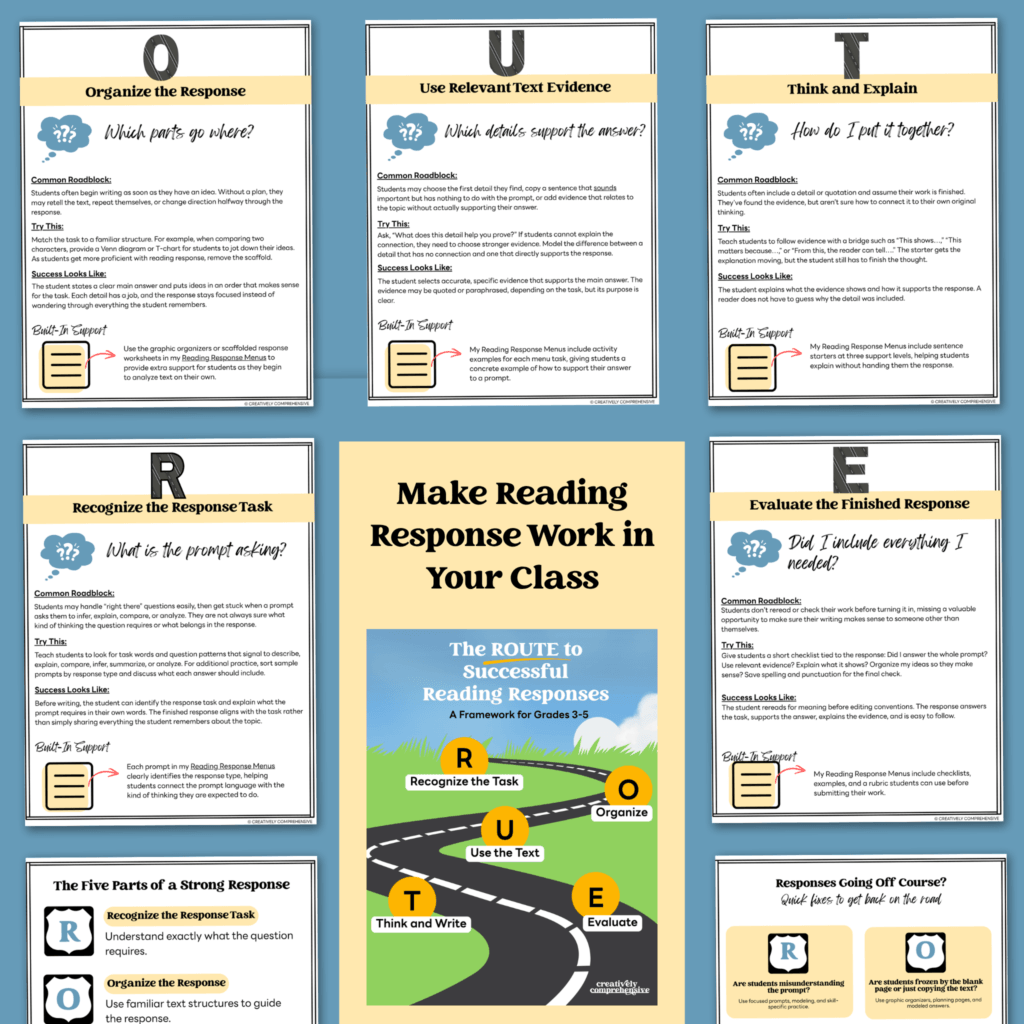
Make Reading Response Work in Your Upper Elementary Classroom
No one sits down on the first day and writes a perfectly organized, evidence-filled reading response. Even the strongest readers aren’t ready for that from the start. It’s a bit like expecting someone to finish a marathon after just one warm-up stretch. Reading response isn’t one single task; it’s a whole set of skills. Students need time, structure, and plenty of modeling to learn how to organize their thoughts, support them with evidence, and share them clearly.
This is where you come in with scaffolded support. The steps you take here do more than get students writing; they help students start to think like readers who can explain what they notice. With the right supports in place, students will gradually be able to take on more responsibility until writing thoughtful responses feels like second nature.
Here are a few ways you can get started:
Give students language they can grab onto while their confidence catches up.
Sentence stems turn the vague “I liked it” into something rooted in text and reasoning. Rotate six to eight stems all year so they become part of students’ mental library:
“The author wants readers to notice…”
“At first I thought __, but now I think __ because…”
“A pattern I’m seeing is…”
“This connects to __ because __.”
“The evidence that proves my idea is…”
“The character changed when…”
These stems act like training wheels for academic writing—temporary, but essential.
Choose a short passage, write a brief response in front of students, and narrate your thinking using the same structure: state an idea, find evidence, and explain how the evidence supports the idea. Add a connection or larger insight when the prompt calls for it.
That visible process—seeing the “thinking behind the pen”—is what closes the gap between what teachers expect and what students actually produce. Just remember- you’re going to have to repeat this procedure many, many times before students take ownership!
Once students are more confident with writing down their responses, train them to use a rubric that will cut back on your grading time. Students get the benefit of learning to go back and assess their own effort, and you get the benefit of being able to breeze through grading 25 notebooks!
When writing still feels heavy, choice makes it doable.
Offer multiple ways to meet the same standard—write a paragraph, sketch and explain, record a short audio reflection, or make a one-slide summary. The product changes, but the thinking doesn’t: every option still requires evidence, explanation, and connection.
All of your students vary at reading and writing proficiency, but you certainly don’t have time to individualize reading response activities for everyone. Meet students where they are by adapting some of the ideas above. The goal is to get everyone to read and respond on their level.
Why These Work
Reading response isn’t a magic activity—it’s a series of small, explicit habits that build comprehension over time.
Research backs it up: students who explain, summarize, and respond with evidence show higher comprehension than peers who simply record pages or answer recall questions.
📚 Want to dig more into the how and why? Here are a few sources worth exploring:
How Much Time Should Reading Response Take?
Let’s face it: time in the classroom is always in short supply, and teachers have to be choosy about what makes it into the schedule. But reading response is worth carving out space for because the payoff is real. It doesn’t need to be a long ordeal. Most teachers find that a quick 10 to 15 minutes each day does the job. Keep it short and consistent and focus on building stamina with both writing and thinking.
What does this look like in the classroom? Depending on your ELA block, this could be a part of independent reading time or a designated center activity. For added accoutability, schedule a small group time once a week to look over notebooks and see what your students have been working on.
Let’s be real. Not everything deserves an essay in the margins. You’re not trying to turn every student into a literary critic. You’re building thinkers. The trick is to keep your feedback quick, targeted, and easy for students to use.
Streamline Your System
Set up a dedicated reading response notebook or journal for each student. This helps you avoid chasing half-finished worksheets or stray papers around the room, and gives students an organized space to build a routine. With notebooks, it’s easier to track progress and offer quick feedback, so the focus stays on growing comprehension instead of grading for composition.
Spot Check Daily. Grade Weekly.
You don’t need to score every notebook every day. Spot-check three to five students daily while the class is writing.
Leave quick notes like “Add evidence” or “Explain why” in real time.
Rotate through the roster so every student gets feedback at least once per week.
By the end of the week, those micro-check-ins mean you’ve already seen each student’s thinking evolve. When you do your formal grading, there are fewer surprises—and far fewer avoidable mistakes.
Continuous monitoring shifts feedback from reactive (“Here’s what you missed”) to proactive (“You already fixed this before turning it in”).
Batch Grading for Sanity
On your designated grading day, pick one focus for the week—maybe evidence quality, or how clearly students explained their ideas.
Skim, note trends, and stop writing paragraphs of feedback. The patterns you see will tell you what you need to know. From there, you can decide if the whole class needs a refresher, or if there are certain students who may need one on one assistance.
And of course, if you train students to use a rubric, you can simply use the same rubric to grade. This means no surprises for students (or their parents) when notebooks are returned to them.
Student Self-Checks
Speaking of rubrics, this is possibly the most powerful tool you can add when it comes to a reading response routine in your classroom.
Self-assessment builds ownership, and research backs it up—rubric-guided self-checks correlate with measurable gains in performance and more accurate self-judgment (ScienceDirect).
When the criteria is clear, student buy-in increases, because they’ll feel like they earned their grade as opposed to just receiving it.
Saving Time with Reading Response Menus
Here’s the part no one tells you: a menu system cuts your grading time in half.
You’re not juggling 25 unrelated prompts, you’re monitoring consistent skills through rotating formats.
Menus naturally:
Standardize expectations (every task aligns with the same comprehension goal).
Give you immediate familiarity—you know exactly what a strong “Connections” or “Text Evidence” response should look like.
Build routine student accountability; they can self-correct mid-week because the structure repeats.
Let you assess thinking patterns, not individual assignments.
With this structure, grading becomes observation: you’re checking growth over time, not individual perfection. Not to mention, you’re not chained to your computer at 11pm on a Saturday night looking for fresh new reading response questions.
Top Tip
Set a timer for each notebook you grade, and try to get yourself to under one minute per notebook.
A Sample Weekly Reading Response Routine
Reading response becomes easier for students when the routine is predictable. Instead of assigning a prompt and hoping students know how to handle it, you can build the work across the week so students see the process, practice it with support, and gradually complete more of the thinking independently.
This type of weekly routine works especially well at the beginning of the year or whenever you are introducing a new response skill.
| Day | Focus | What Students Do |
|---|---|---|
| Monday | Model | Watch a short response being completed using a shared text. Notice how the response states an idea, includes evidence, and explains the thinking. |
| Tuesday | Guided Practice | Work through a response together or with a partner using a familiar text. Students practice finding evidence and explaining how it supports their answer. |
| Wednesday | Independent Response | Choose or complete a response prompt using their own reading text. Students apply the same structure with less teacher support. |
| Thursday | Peer Discussion and Revision | Share thinking with a partner or small group, compare evidence, and revise one part of the response for clarity or detail. |
| Friday | Reflection and Feedback | Use a checklist or rubric to review the response, reflect on progress, and receive targeted teacher feedback. |
This routine does not mean students need to complete a lengthy graded response every day. Some days are for modeling, discussing, practicing, or revising. The consistent part is the thinking process: students learn to make a point about the text, support it, and explain their reasoning.
Once students are comfortable with the routine, it can become more flexible. Students may work independently for more than one day, choose from response options, or use the same process during centers, book clubs, or independent reading.
A repeatable reading response menu fits naturally into this structure because students can focus on the comprehension work instead of waiting for a new set of directions each time they respond.
Common Challenges (and Quick Fixes)
If you’ve tried reading response and felt frustrated by what your students turned in—maybe the answers were too brief, the writing was all pictures, or kids just seemed lost—you’re not alone. It’s easy to think the problem is motivation, but most of the time, students just need more structure and clearer directions.
When reading response doesn’t work, it’s rarely because students can’t do it. The breakdown usually occurs because students don’t know what to do. A few simple tweaks, along with clear routines, can make all the difference for both student success and your own peace of mind.
Here are some common issues that pop up when trying to introduce reading response, and how to solve them:
The One-Sentence Syndrome
The problem:
Every answer is some version of “I liked it because it was fun.”
The fix:
Don’t demand “more” writing—demand “specific” writing.
Give sentence stems that force depth (“The author wants readers to notice…”), and model what one strong paragraph looks like. Label the parts—claim, evidence, explain—and have students copy that pattern for a week straight.
Don’t think of it as you doing all the work. Think of it as students getting reps in before the big game. They need losts of practice, especially if they’re not used to putting their thoughts into writing.
The Reluctant Writer
The problem:
They can talk about the book for ten minutes but write four words on paper.
The fix:
Let them say it before they write it. Start with oral responses. Then, show students how what they say can be written on a graphic organizer. Eventually, show them how to use the organizer to construct their responses in paragraph form.
These students have lots to say, they just aren’t sure how to get it out on paper. Scaffold slowly and you’ll get them there!
The "I Forgot" Crowd
The problem:
Inconsistent responses or missing entries because there’s “no time.”
The fix:
Keep response time short (10–15 minutes), predictable, and in class. Treat it like a warm-up, not homework.
And if you’re using menus, start by highlighting one square per day instead of assigning full menus at once. Bite-sized tasks lower resistance. As the year progresses, you can add more to their plate.
The Accountability Gap
The problem:
Students turn in work that’s rushed, incomplete, or checked at the last minute.
The fix:
Rubrics, rubrics, rubrics. When students start with the result in mind, they’ll be able to write responses that are up to par. It wouldn’t hurt to post some examples around the room either.
Tools + Resources for Upper Elementary Reading Response
Here are some digital and print components you can use to create the reading response system that works for you:
Digital
Google Docs for typed responses and comments.
Seesaw for multimodal entries (draw, voice, text).
Flip for 60–90-second oral responses with captions.
Padlet for a class “response wall.”
Reading response journals with your daily checklist pasted inside front cover.
Choice menus for low-prep differentiation.
Graphic organizers for structure before writing.
Why Reading Response is Worth It
Reading response is one of those routines that seems simple on the surface, but when it’s done well, it makes a real impact. It isn’t just an extra assignment: it’s where comprehension grows into real insight. Giving students ten minutes a day to pause, question, and explain their thinking helps move reading from something they do passively to something they take ownership of. It’s the step that takes students from “I read it” to “I understand it,” and that shift is worth every minute you make for it.
The trick is to keep things doable and visible for everyone. Try using sentence stems to help students get started, require a quick piece of evidence to back up ideas, and encourage self-checks before you collect any work. Keep the routine short and predictable, so you’re building solid habits instead of chasing down assignments. When expectations are easy to see and your feedback stays quick, reading response becomes one of those tasks that saves you time and helps kids become stronger thinkers.
Need help getting started? My Reading Response Menus have been used in thousands of upper elementary classrooms with great success. Within the resource, you’ll find everything you need to create a successful reading response routine in your classroom.
Frequently Asked Questions
Logs track time and titles; responses capture thinking with claims, evidence, and connections. Strategy-based response work is linked with better comprehension outcomes.
Model a simple response structure: claim, evidence, and explanation. Once students can use that consistently, they can add connections or deeper insights when appropriate.
Most classes land on 10–15 minutes for daily entries, with occasional longer looks. Short, frequent practice beats sporadic marathons for comprehension growth.
“This reminds me of __ because __.”
“The author wants readers to notice __.”
“The best evidence for my idea is __ (page __).”
“A pattern I’m seeing is __.”
These echo high-impact comprehension moves (summarize, infer, connect, justify).
To Learn More
The following websites are excellent resources to learn more about reading response:
National Reading Panel. Teaching Children to Read (Comprehension strategies). NICHD
Graham, S., & Hebert, M. A. Writing to Read (Writing about reading improves comprehension). Carnegie Corporation of New York
Reading Rockets summary of research-backed comprehension strategies. Reading Rockets
Research on rubrics + self-assessment improving performance. ScienceDirect
Hi! I'm Marianna

I’m a lifelong educator who helps busy teachers stay passionate about providing engaging, standards-based lessons to their students.
All of my products draw on my 20 years of experience as a K-5 teacher, instructional coach, and private tutor. I’ve worked in all types of environments with all kinds of kids…and I strive to make resources that can be used to make any child a better reader and thinker.
I’m also a huge fan of reading, hockey (Go Panthers!), Bravo TV, Game of Thrones, and any and all doggos. My dog Leo and I enjoy taking walks at the many parks near our house!