by: Marianna Monheim
There are many ways to use student turn-in bins, but the best systems are those that students can use independently every day without asking questions. Whether you organize assignments by work type, subject area, class period, accountability checks, or student self-assessment, clear labels help create routines that save time, reduce lost papers, and build student responsibility.
The TL;DR for Busy Teachers
- Work-type bins separate classwork, homework, and late work.
- Accountability bins encourage students to check their work before submitting.
- Subject-area bins simplify organization in self-contained classrooms.
- Student self-selection bins provide formative assessment data.
- Departmentalized teachers can organize assignments by class period.
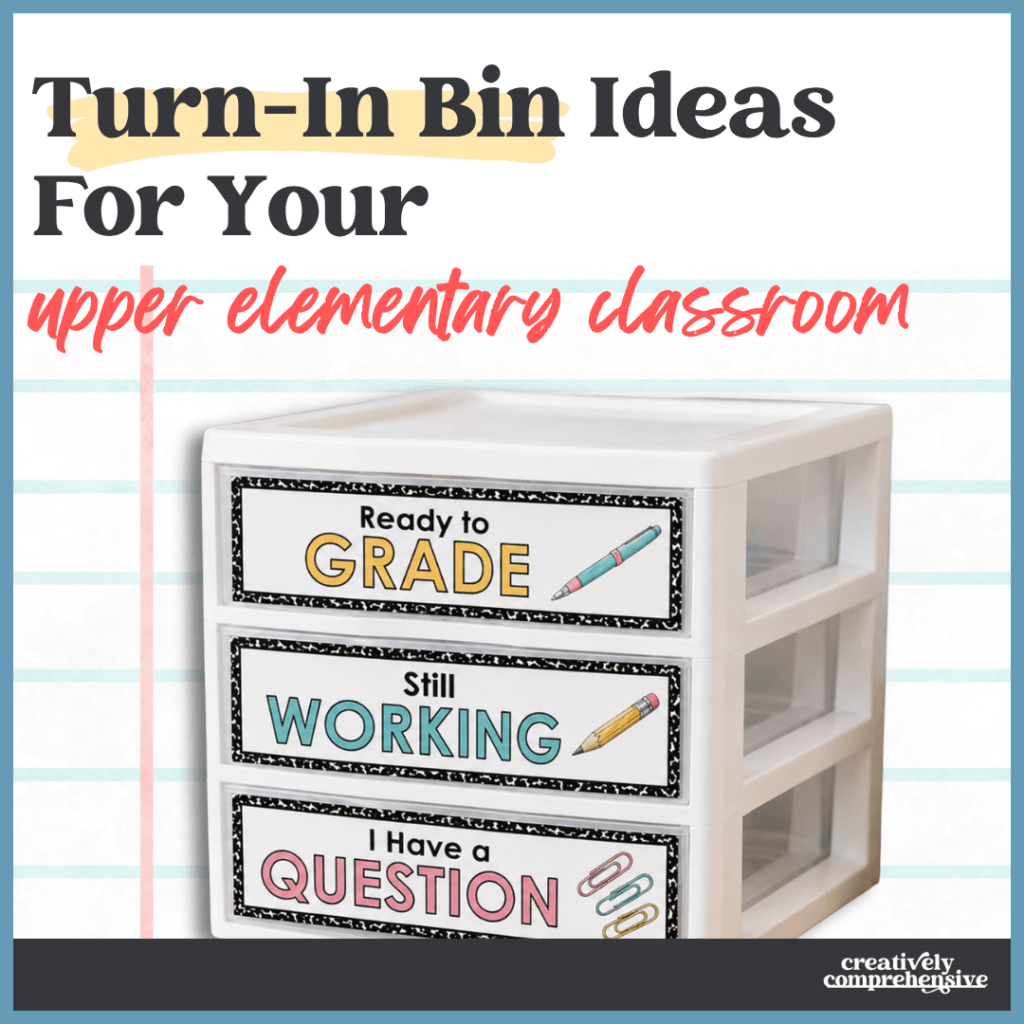
Table of Contents
A student finishes a worksheet, walks across the room, and asks, “Where does this go?”
A few minutes later, another student is standing at your desk with the same question. There’s a math center worksheet on the floor. Homework gets left on the corner of your desk. A finished assignment is shoved into a student desk and never seen again. A missing-name paper joins the stack, because of course it does.
None of these moments is a major problem on its own. But repeated throughout the day, they create extra interruptions, extra sorting, and extra time spent tracking down papers that should have been easy to collect.
A clear turn-in system gives students a routine they can follow independently. They know where their work goes, what information needs to be on it, and what to do when they need help or are not finished yet.
There is no single turn-in setup that works for every classroom. A self-contained teacher collecting multiple subjects may need something different from a departmentalized teacher managing several class periods.
Here are five practical ways to set up turn-in bins, depending on your classroom’s routines and organization.
The Work-Type Turn-In Bin System
Best For:
- Elementary classrooms
- Self-contained teachers
- Teachers implementing a new classroom management system
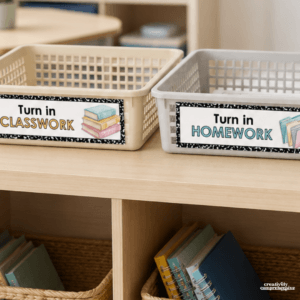
This is one of the simplest and most effective turn-in systems.
Students sort assignments into three categories:
- Classwork
- Homework
- Late Work
Instead of wondering where papers belong, students immediately identify the correct location and move on with their day.
Why Teachers Love It
This system makes grading more efficient because assignments are already sorted when it’s time to review them.
It also creates a clear distinction between on-time and late work, making classroom procedures easier to enforce consistently.
Real Classroom Example
A morning in 4th-grade teacher Jenny’s classroom: before unpacking, students walk to a designated station and place homework in the homework bin. Then they head to their seats to start the rest of the day.
A quick routine change might be all you need.
Label Ideas
- Classwork
- Homework
- Late Work
- Absent Work
- Finished Work
The Accountability Turn-In Bin System
Best For:
- Building student responsibility
- Upper elementary classrooms
- Independent work routines
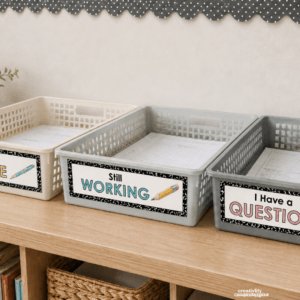
This system takes a standard turn-in bin and adds a simple checklist directly to the label.
Before submitting work, students verify things like:
✓ Name on paper
✓ Date included
✓ Directions followed
✓ Work completed
✓ Best effort shown
The checklist becomes a built-in quality control step.
Why It Works
What mistakes do you see most often in student work? I’m betting they’re procedural:
Missing names.
Skipped directions.
Incomplete pages.
A quick visual reminder can help students catch simple errors before turning in their work.
In The Classroom
Shelly, a 3rd-grade teacher, noticed that she spent several minutes every day trying to identify unnamed papers.
She tried adding a note to her turn-in bin with a simple checklist: Name? Date? Within a few days, she was able to spend less time tracking down no-names and more time grading.
A little note can have a big impact!
Label Idea
Before You Turn It In:
✓ Name
✓ Date
✓ Complete
✓ Checked
The Subject Area Turn-In Bin System
Best For:
- Self-contained elementary classrooms
- Teachers managing multiple subjects
- Color-coded classroom organization
In this system, each subject receives its own collection bin.
Examples include:
- Reading
- Writing
- Math
- Science
- Social Studies
Students simply match their assignment to the correct subject bin.
Why Teachers Choose This System
Sorting happens automatically.
Instead of organizing papers later, teachers collect already-sorted assignments throughout the day.
It also reinforces subject-specific routines and helps students become more organized.
In Your Classroom
Marc, a 5th-grade teacher, teaches five subjects daily. He started using this bin system when his team began weekly math data chats. This way, he can bring the math bin with him to their meetings without having to sort through all the other subjects.
Pro Tip
Match folder colors to your subject bin colors:
- Blue = Reading
- Red = Math
- Green = Science
- Yellow = Social Studies
The visual consistency adds another layer of organization.
The Student Self-Assessment Turn-In System
Best For:
- Formative assessment
- Differentiated instruction
- Student reflection
This system transforms a turn-in station into a quick self-assessment tool.
Students choose a bin based on their confidence level.
Examples:
- I Got This
- I Need a Little Help
- I Need More Practice
Or:
- Confident
- Unsure
- Need Support
Why This System Is Powerful
Before grading a single paper, you already know how students feel about the assignment.
That information is incredibly valuable.
It helps teachers identify misconceptions, plan reteaching opportunities, and adjust instruction before problems grow.
Real Classroom Example
After a fractions lesson, 4th-grade teacher Isabel notices most assignments landed in the “Need More Practice” bin.
Instead of moving forward, she reviews the concept the next day, because her students let her know it was needed.
Added Benefit
Students develop metacognition by reflecting on their own understanding rather than simply completing tasks.
Pro Tip
Just because students are confident doesn’t mean they’re correct. Always verify the “I Got This” bin before moving on.
The Departmentalized or Multiple-Period Turn-In Bin System
Best For:
- Middle school teachers
- Departmentalized elementary classrooms
- Teachers with multiple class sections
When teaching multiple groups of students, organization becomes critical.
Instead of one collection tray, assignments are sorted by class period.
Examples:
- Period 1
- Period 2
- Period 3
Or:
- Homeroom A
- Homeroom B
- Homeroom C
Why It Works
Assignments remain grouped by class from the moment they’re submitted.
Teachers can quickly:
- Track missing work
- Grade by section
- Return papers efficiently
- Monitor class performance trends
In the Real World
Jim, a 5th-grade science teacher with 3 fifth-grade classes, previously spent time sorting papers every afternoon.
After switching to period-specific bins, assignments arrived pre-sorted and ready to grade.
It may not be earth-shattering, but it is time-saving.
Frequently Asked Questions
The ideal number depends on your classroom structure. Some teachers need only one collection station, while others benefit from separate bins by subject, assignment type, or class period.
Many teachers find separate bins helpful because assignments are easier to track, organize, and grade.
Students should verify their name, date, directions, and completion status before submitting work.
Teachers with multiple class periods typically benefit from period-specific bins that keep assignments organized by section.
Absolutely. Self-selection bins allow students to communicate their confidence level, providing valuable instructional data before grading begins.
Final Thoughts
A turn-in bin is a small classroom system, but it can solve a problem teachers deal with all day long.
Without a clear routine, papers end up in all the wrong places: on the teacher’s desk, inside student desks, in the wrong basket, or still sitting in backpacks when they were supposed to be turned in yesterday.
The setup does not need to be complicated. You might organize bins by assignment type, add a simple accountability checklist, separate work by subject, let students self-sort based on confidence, or create a bin system for each class period.
What matters most is that students know what to do without needing to ask every time. In upper elementary, it’s a much-needed opportunity to demonstrate accountability.
Easy-To-Use Turn-In Bin Labels
Once you choose the turn-in system that fits your classroom, the labels are the easy part. This editable set includes ready-to-print options for classwork, homework, late work, subject-area bins, student self-checking, and multiple class periods, so you can make the routine clear from day one.