by: Marianna Monheim
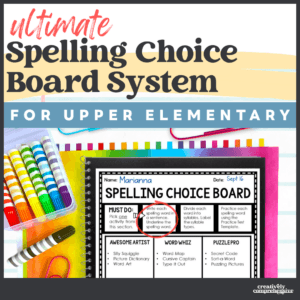
A spelling choice board is a flexible spelling practice system that allows students to work with the same weekly word list through a variety of meaningful activities. Instead of completing the same assignment every week, students choose from different word study tasks that reinforce spelling patterns, vocabulary, word meaning, and written application. The result is greater engagement for students and a reusable, low-prep system teachers can use all year long.
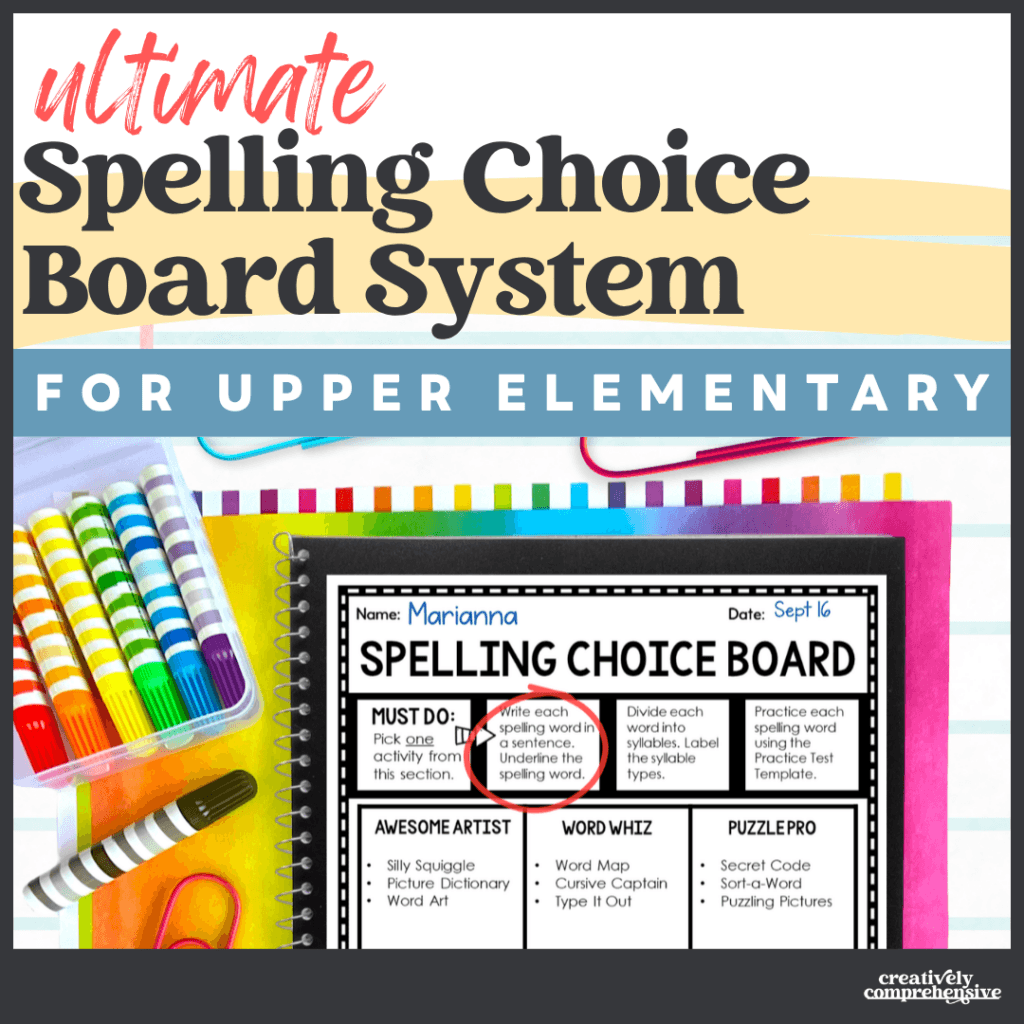
Table of Contents
The TL: DR Rundown
- Work with any spelling word list
- Designed for upper elementary learners
- Encourage meaningful word study, not just memorization
- Includes a variety of multisensory activities
- Appeal to different interests and learning preferences
- Easy to manage, easy to grade, and easy to reuse all year
Spelling practice usually starts out manageable. Students get a list, teachers assign practice, and the routine feels simple enough to repeat.
The problem shows up after a few weeks. The same worksheet starts getting less effort. A new activity helps for a little while, but then that gets old too. Teachers end up searching for fresh spelling practice again, even though what they really need is a routine that can keep working.
That is why a spelling choice board is so useful. It gives students different ways to practice any word list, but the structure stays consistent from week to week. Students get enough variety to stay engaged, and teachers are not rebuilding spelling practice every Monday.
What Is a Spelling Choice Board?
A spelling choice board is a menu of activities students complete using their weekly spelling words. Teachers choose the words, and students choose how they will practice them.
One student might sort words by spelling pattern. Another might write meaningful sentences. Another might complete a visual activity that helps them notice word features, relationships, or tricky parts. The whole class can work with the same list and meet the same expectations, but students are not all locked into the exact same task every time.
That flexibility makes spelling choice boards useful in a lot of places: homework, word work centers, independent practice, small groups, intervention, early finisher activities, and at-home review. Best of all, a well-designed choice board can work with almost any spelling list, so teachers are not creating new practice pages every week.
Why One Type of Spelling Practice Doesn't Work for Every Student
In upper elementary, students do not all respond to spelling practice the same way. Some students like sorting words and looking for patterns. Others do better when they can draw, design, write, explain, or use words in context.
That is one reason traditional spelling homework can feel limiting. When every student completes the same activity every week, some students stay engaged, while others start going through the motions.
A spelling choice board keeps the structure consistent without making the practice feel identical every time. Students still work with their spelling words, complete meaningful practice, and meet clear expectations, but they have different ways to interact with the words. That flexibility helps spelling practice feel more manageable for teachers and more accessible for students.
Purposeful Word Study With Built-In Student Choice
Teachers should not have to choose between spelling practice that is effective and spelling practice students will actually complete with effort. A strong spelling routine needs both.
That means students should be doing more than copying words or filling time. They should be noticing spelling patterns, working with syllables, thinking about word meaning, using words in context, and paying attention to how words work. At the same time, the routine needs enough variety that students are not checked out halfway through the year.
That balance is what makes a spelling choice board useful. It gives students purposeful word study practice with enough choice to keep the work engaging, while giving teachers a repeatable system they can use again and again.
A Multisensory Approach to Spelling Practice
One reason students stay engaged with a spelling choice board is that they aren’t interacting with words in only one way.
Different activities encourage students to:
- Write
- Draw
- Sort
- Categorize
- Analyze
- Compare
- Create
- Apply words in context
The more opportunities students have to actively engage with words, the more likely they are to stay invested in the process.
For example, one activity may encourage students to examine word patterns visually. Another may ask them to sort words by features. Another may require them to apply vocabulary in authentic writing.
Each activity approaches spelling practice from a slightly different angle.
That variety helps keep the experience fresh while still supporting the same learning goals.
Activities That Appeal to Different Learners
One of the biggest strengths of a choice board is that students aren’t locked into a single type of activity.
While all students benefit from working with words in multiple ways, most students naturally gravitate toward certain types of tasks.
A choice board honors those preferences while still encouraging meaningful practice.
| Students Who Enjoy… | Might Choose Activities Like… |
|---|---|
| Visual tasks | Illustrating words, graphic organizers, word relationships |
| Finding patterns | Sorting activities, word investigations, syllable work |
| Writing | Sentences, stories, vocabulary applications |
| Creativity | Design-based word projects |
| Organization | Categorizing and comparing words |
| Independent work | Self-directed menu activities |
| Collaboration | Partner and small-group activities |
This balance of structure and choice often leads to greater engagement because students feel ownership over how they complete their work.
Built for Upper Elementary Learners
Many spelling activities on the internet feel geared toward primary grades.
Upper elementary students need something different.
Third, fourth, and fifth graders are ready to move beyond repetitive copying tasks.
They are capable of:
- Analyzing spelling patterns
- Comparing word features
- Investigating word meanings
- Exploring prefixes and suffixes
- Applying words in authentic writing
- Explaining their thinking
A strong spelling choice board respects that growing independence.
It challenges students to think more deeply about words while still maintaining an approachable and engaging format.
What Makes a Year-Long Spelling System Successful?
The most sustainable spelling systems tend to share a few important characteristics.
| Feature | Why It Matters |
| Student Choice | Increases ownership and motivation |
| Consistent Routines | Saves instructional time |
| Multisensory Activities | Keeps practice engaging |
| Meaningful Word Study | Encourages deeper thinking |
| Easy Grading | Makes the system sustainable |
| Flexible Word Lists | Works with existing curriculum |
When these elements work together, spelling practice becomes easier to maintain throughout the year.
How to Keep Students Engaged All Year
Keeping students engaged in spelling practice does not mean teachers need to introduce a brand-new activity every week. That usually creates more work without solving the real problem.
What students need is a balance of familiarity and variety. The routine should be predictable enough that students can complete it independently, but flexible enough that they are not doing the exact same task every time they get new words.
A spelling choice board provides that balance. The expectations stay consistent, the activity options can change, and students get repeated practice without the routine feeling stale by the middle of the year.
Ready to Stop Reinventing Spelling Homework Every Week?
A strong spelling routine does not require teachers to search for new activities every month. It gives them a repeatable framework that works with any spelling list, supports meaningful word study, includes multisensory practice options, and keeps students engaged throughout the year.
When students have purposeful choices and multiple ways to interact with words, spelling practice becomes more than another worksheet. It becomes a system teachers can actually keep using.
For teachers who want the structure already built, this spelling choice board resource includes editable menus, student-friendly directions, practice sheets, and activity slideshows so the routine is ready to start without creating everything from scratch.
Frequently Asked Questions About Spelling Choice Boards
A spelling choice board is a menu of spelling activities that allows students to practice the same weekly word list in different ways. Instead of completing one required assignment, students choose from a variety of word study activities while still working toward the same spelling goals.
Yes. A flexible spelling choice board can be used with district spelling lists, reading program word lists, vocabulary lists, morphology lists, or teacher-created word lists. The activities stay the same while the words change, making the system easy to use all year long.
That visible process—seeing the “thinking behind the pen”—is what closes the gap between what teachers expect and what students actually produce. Just remember- you’re going to have to repeat this procedure many, many times before students take ownership!
The terms are often used interchangeably. Both provide students with a selection of spelling activities to choose from. Some teachers prefer the term “menu” while others use “choice board,” but the goal is the same: giving students structured choices during spelling practice.
Spelling choice boards can be highly effective when the activities encourage students to actively work with words rather than simply copy them. Activities that focus on spelling patterns, syllables, vocabulary, word meaning, and written application often promote deeper engagement and understanding.
Choice increases ownership. When students can select from several meaningful activities, they are often more motivated to complete the work and more invested in the learning process. The structure remains consistent, but students have some control over how they interact with their spelling words.
Absolutely. Choice boards work especially well in grades 3–5 because students are ready for greater independence. Upper elementary learners benefit from opportunities to analyze words, explore patterns, apply vocabulary, and make decisions about their learning while still working within a clear framework.
That depends on your classroom routine and goals. Many teachers require two to four activities per week, while others assign a certain number of points or menu choices. The flexibility of a choice board allows teachers to customize expectations to fit their schedule and students’ needs.
To Learn More
Reading Rockets — Spelling and Word Study
https://www.readingrockets.org/topics/spelling-and-word-study
Reading Rockets — Looking Closely at Spelling in the Classroom
https://www.readingrockets.org/classroom/classroom-strategies/looking-closely-spelling